Designing for the Whole Person: Why Trauma-Informed AI is the Next Frontier of UX
A UX Research & Design Study
Insights
Shifting the Paradigm: From Efficiency to Safety
For years, the industry has optimized conversational AI for speed and brevity. We want the bot to answer quickly, move the user through the funnel, and “resolve” the ticket. However, when AI moves into high stakes sectors like healthcare, government services, or crisis support, efficiency is no longer the primary metric of success. Safety is.
Trauma informed design isn’t a niche requirement for therapy apps, it is a universal framework for building resilient, inclusive products. It acknowledges that at any given moment, a significant percentage of our users are navigating the world through the lens of past or present trauma. This shift means recognizing that AI isn’t just an interface; it’s an interaction that can impact a user’s emotional well being.
The Three Pillars of Trauma Informed Conversational UX
To bridge the gap between clinical theory and digital execution, I have synthesized my research into three actionable pillars. These move beyond standard usability to address the specific neurobiological needs of a user in a state of heightened stress.
1. Predictive Transparency & The Pre Brief
Researched in Cognitive Load Theory suggests that uncertainty is a primary driver of mental fatigue. For a trauma survivor, uncertainty can shift the brain from task mode to threat mode. Unexpected questions or opaque processes can trigger a startle response or heighten anxiety, making information recall difficult and increasing the likelihood of task abandonment.
The Research Finding: Studies in trauma informed care (TIC), such as those outlined by the SAMHSA (Substance Abuse and Mental Health Services Administration) principles, emphasize that Safety is built through predictability. In UX, this translates to clear communication about what to expect next.
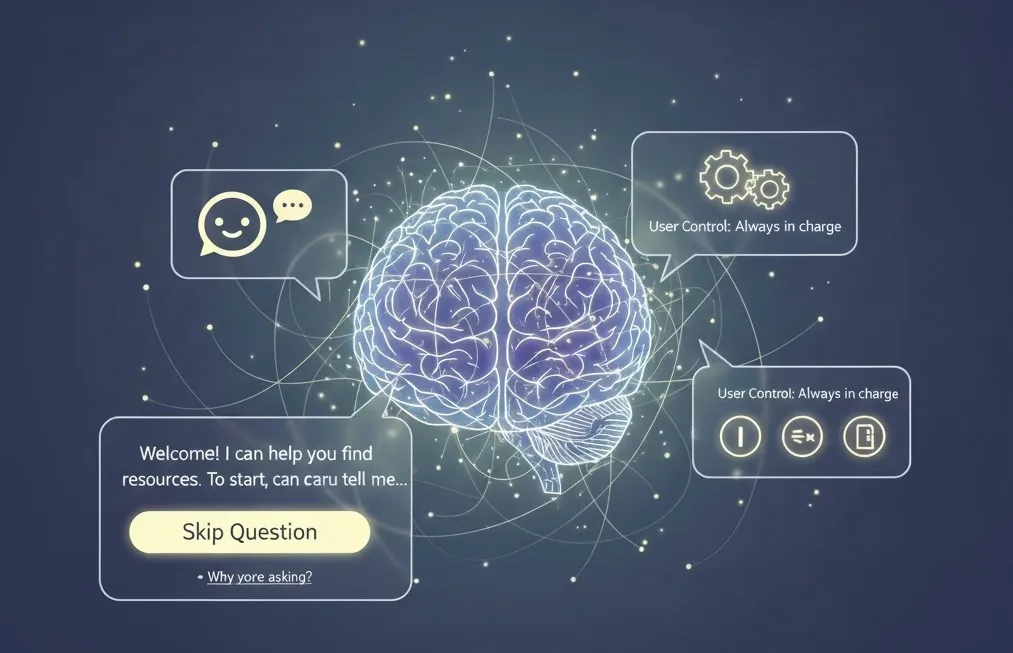
The Execution: Implement a Pre Brief before sensitive data collection. Instead of an AI agent abruptly asking for a history of displacement or health issues, integrate a transparency layer: To determine your eligibility for emergency housing, I’ll need to ask a few questions about your current situation. You can pause or skip at any time.
The Goal: Minimize the cognitive overhead and “startle response” by mapping the conversation’s path and purpose before the user walks it.
2. Radical Agency: Countering “Learned Helplessness”
A core characteristic of trauma is a perceived or actual loss of power and control. Digital interfaces often exacerbate this through “forced linear flows” where a user mustanswer A to get to B, or can’t easily exit a difficult interaction. This can mimic experiences of being trapped or coerced.
The Research Finding: The SAMHSA framework crucially identifies “Empowerment and Choice” as a clinical necessity. Furthermore, a 2023 study on mental health chatbots, published in JMIR Mental Health, found that users reported significantly higher satisfaction and trust when they could “co steer” the conversation and had explicit options to redirect or end the interaction, rather than being “led” by the AI.
The Execution: Design “Non-Linear Escape Valves” and persistent controls. This includes a permanently visible “Skip for Now” button for questions, a “Change Topic” command, or a “Connect to a Human” option that is always accessible. Allowing users to “Clear My Recent History” provides a sense of data control.
The Goal: Transform the user from a passive data-provider into an active collaborator, reinforcing their autonomy and dignity.
3. Contextual Humility & The “Affirmative Loop”
Current Large Language Models (LLMs) are often trained to be helpful assistants, frequently resulting in a tone that feels overly cheerful, generic, or even employs “toxic positivity.” This can feel deeply dismissive or invalidating to a user in genuine distress, creating further emotional harm.
The Research Finding: Research in Affective Computing and user studies on crisis communication demonstrates that users in high-stress states respond better to neutral, validating language and empathetic mirroring than to overly enthusiastic assurances or robotic apologies. A 2022 paper in AI & Societyhighlighted the dangers of AI misinterpreting emotional cues, leading to inappropriate responses.
The Execution: Implement Affirmative Loops instead of generic Resolution Loops. If the AI detects sentiment markers of frustration, anxiety, or trauma, the system should pivot to simpler language, shorter sentences, and explicit validation: I hear that this is a lot to process, and this can be a difficult form to fill out. We can take this one step at a time, or I can connect you to someone who can help further.
The Goal: Avoid Invalidation Trauma by ensuring the AI’s tone and responses align with the user’s emotional gravity and validate their experience.
Integration Tip: The “Stress Test” Research Method
Beyond these pillars, I have adjusted my research methodology. We no longer just test for Time on Task or Completion Rate in isolation. We now conduct Stress Proxied Usability Testing. This involves observing users under simulated cognitive load or interruption, asking: If a user is interrupted or overwhelmed, can they find their place and resume the task easily? and Does the AI recognize when its own limitations or interaction patterns are causing user distress, and can it gracefully de escalate or offer alternatives? By grounding our UX in these research backed pillars and testing for resilience, we move from building smart AI to building wise AI.
Why This Matters Now
We are at an inflection point. As AI becomes the front door for essential services from insurance claims to refugee resettlement, from mental health support to government benefits the stakes of design have never been higher. The integration of trauma-informed principles doesn’t slow down innovation; it makes innovation more robust, ethical, and universally beneficial. By designing for the most vulnerable among us, we inherently create a better, more compassionate, and more effective experience for everyone. A stressed parent, a tired worker, and a trauma survivor all benefit from an interface that is clear, predictable, and respectful.
The transition from Helpful AI to Empathetic AI requires a community effort. We need to center patient voices and lived experiences in our training data and our UX flows. I am currently developing a framework for Trauma Informed Conversational UX, and I am looking to collaborate with designers, researchers, and clinicians who are navigating these same challenges. How is your team thinking about emotional safety in AI? Let’s start the conversation.
More to Discover

Designing for the Whole Person: Why Trauma-Informed AI is the Next Frontier of UX
A UX Research & Design Study
Insights
Shifting the Paradigm: From Efficiency to Safety
For years, the industry has optimized conversational AI for speed and brevity. We want the bot to answer quickly, move the user through the funnel, and “resolve” the ticket. However, when AI moves into high stakes sectors like healthcare, government services, or crisis support, efficiency is no longer the primary metric of success. Safety is.
Trauma informed design isn’t a niche requirement for therapy apps, it is a universal framework for building resilient, inclusive products. It acknowledges that at any given moment, a significant percentage of our users are navigating the world through the lens of past or present trauma. This shift means recognizing that AI isn’t just an interface; it’s an interaction that can impact a user’s emotional well being.
The Three Pillars of Trauma Informed Conversational UX
To bridge the gap between clinical theory and digital execution, I have synthesized my research into three actionable pillars. These move beyond standard usability to address the specific neurobiological needs of a user in a state of heightened stress.
1. Predictive Transparency & The Pre Brief
Researched in Cognitive Load Theory suggests that uncertainty is a primary driver of mental fatigue. For a trauma survivor, uncertainty can shift the brain from task mode to threat mode. Unexpected questions or opaque processes can trigger a startle response or heighten anxiety, making information recall difficult and increasing the likelihood of task abandonment.
The Research Finding: Studies in trauma informed care (TIC), such as those outlined by the SAMHSA (Substance Abuse and Mental Health Services Administration) principles, emphasize that Safety is built through predictability. In UX, this translates to clear communication about what to expect next.
The Execution: Implement a Pre Brief before sensitive data collection. Instead of an AI agent abruptly asking for a history of displacement or health issues, integrate a transparency layer: To determine your eligibility for emergency housing, I’ll need to ask a few questions about your current situation. You can pause or skip at any time.
The Goal: Minimize the cognitive overhead and “startle response” by mapping the conversation’s path and purpose before the user walks it.
2. Radical Agency: Countering “Learned Helplessness”
A core characteristic of trauma is a perceived or actual loss of power and control. Digital interfaces often exacerbate this through “forced linear flows” where a user mustanswer A to get to B, or can’t easily exit a difficult interaction. This can mimic experiences of being trapped or coerced.
The Research Finding: The SAMHSA framework crucially identifies “Empowerment and Choice” as a clinical necessity. Furthermore, a 2023 study on mental health chatbots, published in JMIR Mental Health, found that users reported significantly higher satisfaction and trust when they could “co steer” the conversation and had explicit options to redirect or end the interaction, rather than being “led” by the AI.
The Execution: Design “Non-Linear Escape Valves” and persistent controls. This includes a permanently visible “Skip for Now” button for questions, a “Change Topic” command, or a “Connect to a Human” option that is always accessible. Allowing users to “Clear My Recent History” provides a sense of data control.
The Goal: Transform the user from a passive data-provider into an active collaborator, reinforcing their autonomy and dignity.
3. Contextual Humility & The “Affirmative Loop”
Current Large Language Models (LLMs) are often trained to be helpful assistants, frequently resulting in a tone that feels overly cheerful, generic, or even employs “toxic positivity.” This can feel deeply dismissive or invalidating to a user in genuine distress, creating further emotional harm.
The Research Finding: Research in Affective Computing and user studies on crisis communication demonstrates that users in high-stress states respond better to neutral, validating language and empathetic mirroring than to overly enthusiastic assurances or robotic apologies. A 2022 paper in AI & Societyhighlighted the dangers of AI misinterpreting emotional cues, leading to inappropriate responses.
The Execution: Implement Affirmative Loops instead of generic Resolution Loops. If the AI detects sentiment markers of frustration, anxiety, or trauma, the system should pivot to simpler language, shorter sentences, and explicit validation: I hear that this is a lot to process, and this can be a difficult form to fill out. We can take this one step at a time, or I can connect you to someone who can help further.
The Goal: Avoid Invalidation Trauma by ensuring the AI’s tone and responses align with the user’s emotional gravity and validate their experience.
Integration Tip: The “Stress Test” Research Method
Beyond these pillars, I have adjusted my research methodology. We no longer just test for Time on Task or Completion Rate in isolation. We now conduct Stress Proxied Usability Testing. This involves observing users under simulated cognitive load or interruption, asking: If a user is interrupted or overwhelmed, can they find their place and resume the task easily? and Does the AI recognize when its own limitations or interaction patterns are causing user distress, and can it gracefully de escalate or offer alternatives? By grounding our UX in these research backed pillars and testing for resilience, we move from building smart AI to building wise AI.
Why This Matters Now
We are at an inflection point. As AI becomes the front door for essential services from insurance claims to refugee resettlement, from mental health support to government benefits the stakes of design have never been higher. The integration of trauma-informed principles doesn’t slow down innovation; it makes innovation more robust, ethical, and universally beneficial. By designing for the most vulnerable among us, we inherently create a better, more compassionate, and more effective experience for everyone. A stressed parent, a tired worker, and a trauma survivor all benefit from an interface that is clear, predictable, and respectful.
The transition from Helpful AI to Empathetic AI requires a community effort. We need to center patient voices and lived experiences in our training data and our UX flows. I am currently developing a framework for Trauma Informed Conversational UX, and I am looking to collaborate with designers, researchers, and clinicians who are navigating these same challenges. How is your team thinking about emotional safety in AI? Let’s start the conversation.
More to Discover
Designing for the Whole Person: Why Trauma-Informed AI is the Next Frontier of UX
A UX Research & Design Study
Insights
Shifting the Paradigm: From Efficiency to Safety
For years, the industry has optimized conversational AI for speed and brevity. We want the bot to answer quickly, move the user through the funnel, and “resolve” the ticket. However, when AI moves into high stakes sectors like healthcare, government services, or crisis support, efficiency is no longer the primary metric of success. Safety is.
Trauma informed design isn’t a niche requirement for therapy apps, it is a universal framework for building resilient, inclusive products. It acknowledges that at any given moment, a significant percentage of our users are navigating the world through the lens of past or present trauma. This shift means recognizing that AI isn’t just an interface; it’s an interaction that can impact a user’s emotional well being.
The Three Pillars of Trauma Informed Conversational UX
To bridge the gap between clinical theory and digital execution, I have synthesized my research into three actionable pillars. These move beyond standard usability to address the specific neurobiological needs of a user in a state of heightened stress.
1. Predictive Transparency & The Pre Brief
Researched in Cognitive Load Theory suggests that uncertainty is a primary driver of mental fatigue. For a trauma survivor, uncertainty can shift the brain from task mode to threat mode. Unexpected questions or opaque processes can trigger a startle response or heighten anxiety, making information recall difficult and increasing the likelihood of task abandonment.
The Research Finding: Studies in trauma informed care (TIC), such as those outlined by the SAMHSA (Substance Abuse and Mental Health Services Administration) principles, emphasize that Safety is built through predictability. In UX, this translates to clear communication about what to expect next.
The Execution: Implement a Pre Brief before sensitive data collection. Instead of an AI agent abruptly asking for a history of displacement or health issues, integrate a transparency layer: To determine your eligibility for emergency housing, I’ll need to ask a few questions about your current situation. You can pause or skip at any time.
The Goal: Minimize the cognitive overhead and “startle response” by mapping the conversation’s path and purpose before the user walks it.
2. Radical Agency: Countering “Learned Helplessness”
A core characteristic of trauma is a perceived or actual loss of power and control. Digital interfaces often exacerbate this through “forced linear flows” where a user mustanswer A to get to B, or can’t easily exit a difficult interaction. This can mimic experiences of being trapped or coerced.
The Research Finding: The SAMHSA framework crucially identifies “Empowerment and Choice” as a clinical necessity. Furthermore, a 2023 study on mental health chatbots, published in JMIR Mental Health, found that users reported significantly higher satisfaction and trust when they could “co steer” the conversation and had explicit options to redirect or end the interaction, rather than being “led” by the AI.
The Execution: Design “Non-Linear Escape Valves” and persistent controls. This includes a permanently visible “Skip for Now” button for questions, a “Change Topic” command, or a “Connect to a Human” option that is always accessible. Allowing users to “Clear My Recent History” provides a sense of data control.
The Goal: Transform the user from a passive data-provider into an active collaborator, reinforcing their autonomy and dignity.
3. Contextual Humility & The “Affirmative Loop”
Current Large Language Models (LLMs) are often trained to be helpful assistants, frequently resulting in a tone that feels overly cheerful, generic, or even employs “toxic positivity.” This can feel deeply dismissive or invalidating to a user in genuine distress, creating further emotional harm.
The Research Finding: Research in Affective Computing and user studies on crisis communication demonstrates that users in high-stress states respond better to neutral, validating language and empathetic mirroring than to overly enthusiastic assurances or robotic apologies. A 2022 paper in AI & Societyhighlighted the dangers of AI misinterpreting emotional cues, leading to inappropriate responses.
The Execution: Implement Affirmative Loops instead of generic Resolution Loops. If the AI detects sentiment markers of frustration, anxiety, or trauma, the system should pivot to simpler language, shorter sentences, and explicit validation: I hear that this is a lot to process, and this can be a difficult form to fill out. We can take this one step at a time, or I can connect you to someone who can help further.
The Goal: Avoid Invalidation Trauma by ensuring the AI’s tone and responses align with the user’s emotional gravity and validate their experience.
Integration Tip: The “Stress Test” Research Method
Beyond these pillars, I have adjusted my research methodology. We no longer just test for Time on Task or Completion Rate in isolation. We now conduct Stress Proxied Usability Testing. This involves observing users under simulated cognitive load or interruption, asking: If a user is interrupted or overwhelmed, can they find their place and resume the task easily? and Does the AI recognize when its own limitations or interaction patterns are causing user distress, and can it gracefully de escalate or offer alternatives? By grounding our UX in these research backed pillars and testing for resilience, we move from building smart AI to building wise AI.
Why This Matters Now
We are at an inflection point. As AI becomes the front door for essential services from insurance claims to refugee resettlement, from mental health support to government benefits the stakes of design have never been higher. The integration of trauma-informed principles doesn’t slow down innovation; it makes innovation more robust, ethical, and universally beneficial. By designing for the most vulnerable among us, we inherently create a better, more compassionate, and more effective experience for everyone. A stressed parent, a tired worker, and a trauma survivor all benefit from an interface that is clear, predictable, and respectful.
The transition from Helpful AI to Empathetic AI requires a community effort. We need to center patient voices and lived experiences in our training data and our UX flows. I am currently developing a framework for Trauma Informed Conversational UX, and I am looking to collaborate with designers, researchers, and clinicians who are navigating these same challenges. How is your team thinking about emotional safety in AI? Let’s start the conversation.