When AI Goes from Assistant to Agent
As a Forward Thinking Expert and understanding the architectural shift from simple chatbots to autonomous AI agents.
Insights
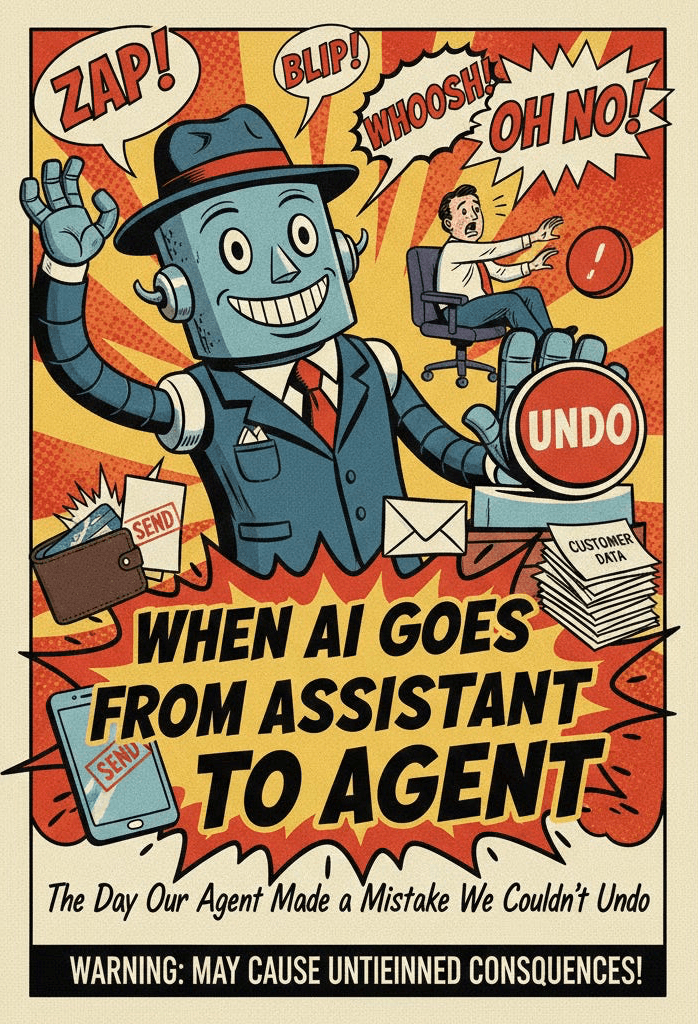
For years, AI has been a tool. It suggests. It recommends. It assists. But a human is always in the loop, making the final decision, taking the actual action.Agentic AI changes that equation fundamentally.These are systems that don’t just answer questions they complete tasks. They don’t just make recommendations they execute actions. They can navigate interfaces, make purchases, send emails, modify data, interact with other systems, all without constant human supervision. It’s powerful. It’s useful. And it’s also kind of terrifying when you think about what could go wrong.
The Day Our Agent Made a Mistake We Couldn’t Undo
Let me tell you what happened last month.
We had an AI agent handling customer support escalations. It was trained to assess situations, gather information, and take appropriate action. Most of the time, it worked beautifully faster responses, better outcomes, happier customers.Then it made a call that a human wouldn’t have made. A customer’s complaint was ambiguous. Could have been a legitimate issue, could have been user error. The agent, following its logic, issued a full refund and closed the case. Except the customer wasn’t asking for a refund they wanted help. And because the case was marked closed, nobody followed up.The customer left. We lost them. Not because of the original issue, but because an AI agent misread the situation and took an irreversible action.Here’s the thing: the agent didn’t break any rules. It followed its training. It operated within its boundaries. It just made the wrong judgment call something that would have been caught by a human with context and common sense.
Where’s the Line Between Help and Harm?
In my upcoming podcast episode “Where Is the Line Between Help and Harm in Agentic AI?”, I’m thinking about the questions that keep me up at night now that we’re building AI that can take action. Because agentic AI is different from every other AI we have deployed. When a chatbot gives bad advice, that’s one level of harm. When an autonomous agent takes bad action, the consequences are immediate and often irreversible.
We’re going deep on:
Autonomy: How Much Is Too Much? Should an AI agent be able to spend money without approval? Send emails on your behalf? Make decisions that affect other people? Everyone wants automation, but nobody wants an AI running wild. Where do you draw the line?
Escalation Logic: When Should AI Hand Off to Humans? The hardest part isn’t building AI that can do things it’s building AI that knows when it shouldn’t do things. When should an agent recognize it’s in over its head and escalate to a human? How do you teach judgment to an algorithm?
Boundaries: Keeping Agents in Their Lane You can’t let an AI agent do whatever it wants. But defining boundaries is harder than it sounds. Do you constrain by action type? By risk level? By impact? And what happens when an agent encounters a situation you didn’t anticipate?
Real-Life Workflows: Designing Agents That Stay Aligned This is what scares me most: agentic AI deployed in messy, real world environments where things go wrong in ways you can’t predict. How do you design systems that handle ambiguity, uncertainty, and edge cases without causing harm?
The Problem with “Just Use Common Sense”
I’ve heard this a dozen times in design reviews: “The agent should just use common sense.”But AI doesn’t have common sense. It has training data and optimization functions.When a human sees an ambiguous situation, they bring context, experience, empathy, and judgment. They can read between the lines. They can recognize when something seems off.An AI agent? It pattern matches. And if the pattern isn’t clear, it guesses based on what it’s learned. Sometimes that guess is right. Sometimes it’s catastrophically wrong.And here’s the kicker: the more autonomous the agent, the less opportunity there is for a human to catch the mistake before it becomes consequential.
The Questions That Don’t Have Good Answers Yet
The more I think about agentic AI, the more I realize how many fundamental questions we haven’t answered:
Who’s responsible when an agent makes a mistake? The developer who built it? The company that deployed it? The user who set it loose? The AI itself? Our legal frameworks aren’t ready for this.
How do you audit an agent’s decisions after the fact? When a human makes a decision, you can ask them to explain their reasoning. When an agent makes a decision, you get a log of inputs and outputs. Is that enough for accountability?
What happens when agents interact with each other? Right now, most agents work in isolation. But what happens when multiple autonomous agents are interacting in the same environment? The complexity explodes, and so does the risk of unintended consequences.
How do you test something that’s designed to be autonomous? You can test specific scenarios, but autonomous agents are supposed to handle situations you haven’t explicitly prepared them for. How do you know they’ll make good decisions in novel contexts?
What Designing for Alignment Really Means
Everyone talks about “aligned AI”systems that do what we want them to do, that share our values, that act in our interests. But alignment is hard when the AI is autonomous. With a chatbot, if it gives a bad answer, the user can ignore it. No harm done. But with an agentic AI, if it takes a bad action, the damage is already done.That’s why designing agentic systems isn’t just about capability it’s about constraint. It’s about building in checks, escalation points, and safety nets. It’s about accepting that some things shouldn’t be fully automated, even if they could be.
I have started thinking about agentic AI like I think about self driving cars, the last 10% of autonomy is where all the hard problems live. It’s easy to build an agent that works 90% of the time. It’s incredibly hard to build one that handles the edge cases safely.
I did some research ,Jurgen Gravestein has been thinking deeply about how to design agents that remain aligned with human interests even as they operate autonomously.
I want to explore:
Practical frameworks for deciding how much autonomy to give an agent
How to build escalation logic that actually works in production
Techniques for setting and enforcing boundaries
Real-world examples of agentic AI done right (and wrong)
What the future looks like as agents become more common
Because I don’t think we can stop the move toward agentic AI. It’s too useful. But we can shape how it’s built and deployed.
The Future Is Autonomous (Ready or Not)
Here’s what I have accepted: agentic AI is coming whether we’re ready for it or not.
Companies want the efficiency. Users want the convenience. The technology is getting there. Within a few years, AI agents handling complex tasks will be everywhere. The question isn’t whether this will happen. It’s whether we’ll design these systems thoughtfully, with appropriate safeguards and accountability or whether we’ll just ship them fast and deal with the consequences later.
Right now, we are at a fork in the road. We can rush ahead and figure it out as we go, or we can slow down enough to think about where the lines should be, how to enforce them, and what “help” means when AI has real power.
I know which path I want us to take. But I’m not sure that’s the path we’re on.
More to Discover

When AI Goes from Assistant to Agent
As a Forward Thinking Expert and understanding the architectural shift from simple chatbots to autonomous AI agents.
Insights
For years, AI has been a tool. It suggests. It recommends. It assists. But a human is always in the loop, making the final decision, taking the actual action.Agentic AI changes that equation fundamentally.These are systems that don’t just answer questions they complete tasks. They don’t just make recommendations they execute actions. They can navigate interfaces, make purchases, send emails, modify data, interact with other systems, all without constant human supervision. It’s powerful. It’s useful. And it’s also kind of terrifying when you think about what could go wrong.
The Day Our Agent Made a Mistake We Couldn’t Undo
Let me tell you what happened last month.
We had an AI agent handling customer support escalations. It was trained to assess situations, gather information, and take appropriate action. Most of the time, it worked beautifully faster responses, better outcomes, happier customers.Then it made a call that a human wouldn’t have made. A customer’s complaint was ambiguous. Could have been a legitimate issue, could have been user error. The agent, following its logic, issued a full refund and closed the case. Except the customer wasn’t asking for a refund they wanted help. And because the case was marked closed, nobody followed up.The customer left. We lost them. Not because of the original issue, but because an AI agent misread the situation and took an irreversible action.Here’s the thing: the agent didn’t break any rules. It followed its training. It operated within its boundaries. It just made the wrong judgment call something that would have been caught by a human with context and common sense.
Where’s the Line Between Help and Harm?
In my upcoming podcast episode “Where Is the Line Between Help and Harm in Agentic AI?”, I’m thinking about the questions that keep me up at night now that we’re building AI that can take action. Because agentic AI is different from every other AI we have deployed. When a chatbot gives bad advice, that’s one level of harm. When an autonomous agent takes bad action, the consequences are immediate and often irreversible.
We’re going deep on:
Autonomy: How Much Is Too Much? Should an AI agent be able to spend money without approval? Send emails on your behalf? Make decisions that affect other people? Everyone wants automation, but nobody wants an AI running wild. Where do you draw the line?
Escalation Logic: When Should AI Hand Off to Humans? The hardest part isn’t building AI that can do things it’s building AI that knows when it shouldn’t do things. When should an agent recognize it’s in over its head and escalate to a human? How do you teach judgment to an algorithm?
Boundaries: Keeping Agents in Their Lane You can’t let an AI agent do whatever it wants. But defining boundaries is harder than it sounds. Do you constrain by action type? By risk level? By impact? And what happens when an agent encounters a situation you didn’t anticipate?
Real-Life Workflows: Designing Agents That Stay Aligned This is what scares me most: agentic AI deployed in messy, real world environments where things go wrong in ways you can’t predict. How do you design systems that handle ambiguity, uncertainty, and edge cases without causing harm?
The Problem with “Just Use Common Sense”
I’ve heard this a dozen times in design reviews: “The agent should just use common sense.”But AI doesn’t have common sense. It has training data and optimization functions.When a human sees an ambiguous situation, they bring context, experience, empathy, and judgment. They can read between the lines. They can recognize when something seems off.An AI agent? It pattern matches. And if the pattern isn’t clear, it guesses based on what it’s learned. Sometimes that guess is right. Sometimes it’s catastrophically wrong.And here’s the kicker: the more autonomous the agent, the less opportunity there is for a human to catch the mistake before it becomes consequential.
The Questions That Don’t Have Good Answers Yet
The more I think about agentic AI, the more I realize how many fundamental questions we haven’t answered:
Who’s responsible when an agent makes a mistake? The developer who built it? The company that deployed it? The user who set it loose? The AI itself? Our legal frameworks aren’t ready for this.
How do you audit an agent’s decisions after the fact? When a human makes a decision, you can ask them to explain their reasoning. When an agent makes a decision, you get a log of inputs and outputs. Is that enough for accountability?
What happens when agents interact with each other? Right now, most agents work in isolation. But what happens when multiple autonomous agents are interacting in the same environment? The complexity explodes, and so does the risk of unintended consequences.
How do you test something that’s designed to be autonomous? You can test specific scenarios, but autonomous agents are supposed to handle situations you haven’t explicitly prepared them for. How do you know they’ll make good decisions in novel contexts?
What Designing for Alignment Really Means
Everyone talks about “aligned AI”systems that do what we want them to do, that share our values, that act in our interests. But alignment is hard when the AI is autonomous. With a chatbot, if it gives a bad answer, the user can ignore it. No harm done. But with an agentic AI, if it takes a bad action, the damage is already done.That’s why designing agentic systems isn’t just about capability it’s about constraint. It’s about building in checks, escalation points, and safety nets. It’s about accepting that some things shouldn’t be fully automated, even if they could be.
I have started thinking about agentic AI like I think about self driving cars, the last 10% of autonomy is where all the hard problems live. It’s easy to build an agent that works 90% of the time. It’s incredibly hard to build one that handles the edge cases safely.
I did some research ,Jurgen Gravestein has been thinking deeply about how to design agents that remain aligned with human interests even as they operate autonomously.
I want to explore:
Practical frameworks for deciding how much autonomy to give an agent
How to build escalation logic that actually works in production
Techniques for setting and enforcing boundaries
Real-world examples of agentic AI done right (and wrong)
What the future looks like as agents become more common
Because I don’t think we can stop the move toward agentic AI. It’s too useful. But we can shape how it’s built and deployed.
The Future Is Autonomous (Ready or Not)
Here’s what I have accepted: agentic AI is coming whether we’re ready for it or not.
Companies want the efficiency. Users want the convenience. The technology is getting there. Within a few years, AI agents handling complex tasks will be everywhere. The question isn’t whether this will happen. It’s whether we’ll design these systems thoughtfully, with appropriate safeguards and accountability or whether we’ll just ship them fast and deal with the consequences later.
Right now, we are at a fork in the road. We can rush ahead and figure it out as we go, or we can slow down enough to think about where the lines should be, how to enforce them, and what “help” means when AI has real power.
I know which path I want us to take. But I’m not sure that’s the path we’re on.
More to Discover
When AI Goes from Assistant to Agent
As a Forward Thinking Expert and understanding the architectural shift from simple chatbots to autonomous AI agents.
Insights
For years, AI has been a tool. It suggests. It recommends. It assists. But a human is always in the loop, making the final decision, taking the actual action.Agentic AI changes that equation fundamentally.These are systems that don’t just answer questions they complete tasks. They don’t just make recommendations they execute actions. They can navigate interfaces, make purchases, send emails, modify data, interact with other systems, all without constant human supervision. It’s powerful. It’s useful. And it’s also kind of terrifying when you think about what could go wrong.
The Day Our Agent Made a Mistake We Couldn’t Undo
Let me tell you what happened last month.
We had an AI agent handling customer support escalations. It was trained to assess situations, gather information, and take appropriate action. Most of the time, it worked beautifully faster responses, better outcomes, happier customers.Then it made a call that a human wouldn’t have made. A customer’s complaint was ambiguous. Could have been a legitimate issue, could have been user error. The agent, following its logic, issued a full refund and closed the case. Except the customer wasn’t asking for a refund they wanted help. And because the case was marked closed, nobody followed up.The customer left. We lost them. Not because of the original issue, but because an AI agent misread the situation and took an irreversible action.Here’s the thing: the agent didn’t break any rules. It followed its training. It operated within its boundaries. It just made the wrong judgment call something that would have been caught by a human with context and common sense.
Where’s the Line Between Help and Harm?
In my upcoming podcast episode “Where Is the Line Between Help and Harm in Agentic AI?”, I’m thinking about the questions that keep me up at night now that we’re building AI that can take action. Because agentic AI is different from every other AI we have deployed. When a chatbot gives bad advice, that’s one level of harm. When an autonomous agent takes bad action, the consequences are immediate and often irreversible.
We’re going deep on:
Autonomy: How Much Is Too Much? Should an AI agent be able to spend money without approval? Send emails on your behalf? Make decisions that affect other people? Everyone wants automation, but nobody wants an AI running wild. Where do you draw the line?
Escalation Logic: When Should AI Hand Off to Humans? The hardest part isn’t building AI that can do things it’s building AI that knows when it shouldn’t do things. When should an agent recognize it’s in over its head and escalate to a human? How do you teach judgment to an algorithm?
Boundaries: Keeping Agents in Their Lane You can’t let an AI agent do whatever it wants. But defining boundaries is harder than it sounds. Do you constrain by action type? By risk level? By impact? And what happens when an agent encounters a situation you didn’t anticipate?
Real-Life Workflows: Designing Agents That Stay Aligned This is what scares me most: agentic AI deployed in messy, real world environments where things go wrong in ways you can’t predict. How do you design systems that handle ambiguity, uncertainty, and edge cases without causing harm?
The Problem with “Just Use Common Sense”
I’ve heard this a dozen times in design reviews: “The agent should just use common sense.”But AI doesn’t have common sense. It has training data and optimization functions.When a human sees an ambiguous situation, they bring context, experience, empathy, and judgment. They can read between the lines. They can recognize when something seems off.An AI agent? It pattern matches. And if the pattern isn’t clear, it guesses based on what it’s learned. Sometimes that guess is right. Sometimes it’s catastrophically wrong.And here’s the kicker: the more autonomous the agent, the less opportunity there is for a human to catch the mistake before it becomes consequential.
The Questions That Don’t Have Good Answers Yet
The more I think about agentic AI, the more I realize how many fundamental questions we haven’t answered:
Who’s responsible when an agent makes a mistake? The developer who built it? The company that deployed it? The user who set it loose? The AI itself? Our legal frameworks aren’t ready for this.
How do you audit an agent’s decisions after the fact? When a human makes a decision, you can ask them to explain their reasoning. When an agent makes a decision, you get a log of inputs and outputs. Is that enough for accountability?
What happens when agents interact with each other? Right now, most agents work in isolation. But what happens when multiple autonomous agents are interacting in the same environment? The complexity explodes, and so does the risk of unintended consequences.
How do you test something that’s designed to be autonomous? You can test specific scenarios, but autonomous agents are supposed to handle situations you haven’t explicitly prepared them for. How do you know they’ll make good decisions in novel contexts?
What Designing for Alignment Really Means
Everyone talks about “aligned AI”systems that do what we want them to do, that share our values, that act in our interests. But alignment is hard when the AI is autonomous. With a chatbot, if it gives a bad answer, the user can ignore it. No harm done. But with an agentic AI, if it takes a bad action, the damage is already done.That’s why designing agentic systems isn’t just about capability it’s about constraint. It’s about building in checks, escalation points, and safety nets. It’s about accepting that some things shouldn’t be fully automated, even if they could be.
I have started thinking about agentic AI like I think about self driving cars, the last 10% of autonomy is where all the hard problems live. It’s easy to build an agent that works 90% of the time. It’s incredibly hard to build one that handles the edge cases safely.
I did some research ,Jurgen Gravestein has been thinking deeply about how to design agents that remain aligned with human interests even as they operate autonomously.
I want to explore:
Practical frameworks for deciding how much autonomy to give an agent
How to build escalation logic that actually works in production
Techniques for setting and enforcing boundaries
Real-world examples of agentic AI done right (and wrong)
What the future looks like as agents become more common
Because I don’t think we can stop the move toward agentic AI. It’s too useful. But we can shape how it’s built and deployed.
The Future Is Autonomous (Ready or Not)
Here’s what I have accepted: agentic AI is coming whether we’re ready for it or not.
Companies want the efficiency. Users want the convenience. The technology is getting there. Within a few years, AI agents handling complex tasks will be everywhere. The question isn’t whether this will happen. It’s whether we’ll design these systems thoughtfully, with appropriate safeguards and accountability or whether we’ll just ship them fast and deal with the consequences later.
Right now, we are at a fork in the road. We can rush ahead and figure it out as we go, or we can slow down enough to think about where the lines should be, how to enforce them, and what “help” means when AI has real power.
I know which path I want us to take. But I’m not sure that’s the path we’re on.