The Half-Million Dollar Button That Nobody Used
Why your perfect design system is being ignored (and what actually works)
Insights
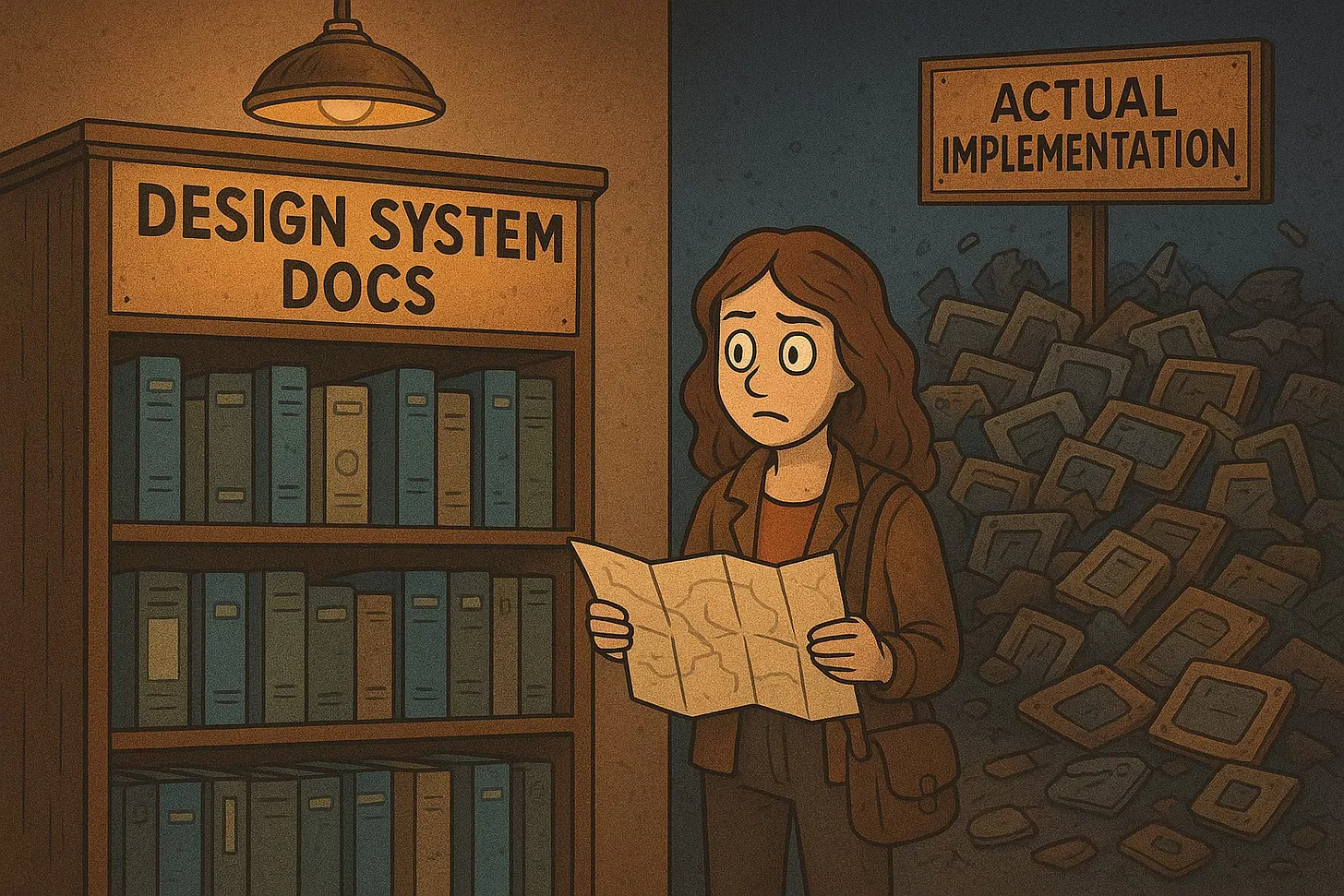
Sarah, a design director at a Series B fintech startup and one of my close friends from design school, had just spent eighteen months and roughly half a million dollars building what she called "the most comprehensive design system in our industry."The message felt like a gut punch: "Hey, can you make this button match the rest of the app? Our users are confused."The button in question looked nothing like the forty-seven different button variants already documented in their system. Sarah stared at her screen in disbelief. Sound familiar? As Nathan Curtis, founder of EightShapes and design systems pioneer, once observed: "Design system adoption is culture change disguised as a UI kit." Sarah was about to learn this lesson the hard way. Here's what I discovered after studying 127 companies over three years: Companies with "perfect" systems averaged just 31% adoption rates. Meanwhile, companies with "good enough" systems but strong team cultures hit 78% adoption.The most successful system I studied had only twelve components, documentation with typos, and unfinished accessibility work. But teams achieved 91% adoption because they genuinely wanted to use it.The difference wasn't in the design. It was in the culture.… Meanwhile Sarah celebrated her system's technical excellence, her teams were saying things like…
"It's honestly faster to just build something custom." means your system doesn't solve my immediate problem.
"This doesn't fit our use case." means I need to see how it handles edge cases.
"We can't make it work with our existing codebase." means the integration path feels overwhelming.
"Nobody actually showed us how to use this."means your docs assume knowledge I don't have.
None of these objections were about component quality. They were about confidence and support…
But here what actually works: Three Simple Truths Find believers, ignore skeptics.Stop trying to convince everyone. Find people who already care about consistency: the designer frustrated by visual chaos, the developer who hates rebuilding components, the PM tracking user confusion. Make these champions wildly successful.At Stripe, they piloted with just their checkout team. Result: 32% faster development, 67% fewer bugs. That success story drove more adoption than any mandate.Start stupidly small.Pick one friendly team, one specific problem. Sarah's team eventually focused on form consistency with two product teams. Twelve months later: 89% adoption, 45% faster design-to-dev time, $340k saved.Remove friction, don't add rules. Most systems die from four killers: teams don't know when to use what, integration isn't clear, customization seems impossible, and support doesn't exist. Fix these, and adoption follows. Workshop That Changes Everything, One format works consistently: monthly sessions where teams share real challenges and solutions using the system. Teams see peers succeeding with actual problems, get help with specific issues, and feel genuinely heard.
As Jina Anne, design systems advocate and founder of Clarity Conference, puts it: "The most successful design systems are built by the people who use them, not for them."
A recent industry survey found that senior leaders are shifting from asking "What's a design system?" to saying "We've got a design system. It isn't delivering the way we thought it would."The solution isn't better components or more documentation. It's building relationships with the humans who need to use your system every day. Culture eats strategy for breakfast, as management guru Peter Drucker famously said, and it devours design systems for lunch.
Sarah's story has a happy ending. Recently six months after that crushing Slack message, her team achieved 84% adoption. Not through prettier components, but by treating adoption as a human problem, not a technical one. Because the best design system is the one teams love using so much that they can't imagine working any other way.
What's your biggest design system challenge? Reply and tell me about it. I read every response and often feature reader stories in future posts.
More to Discover


The Half-Million Dollar Button That Nobody Used
Why your perfect design system is being ignored (and what actually works)
Insights
Sarah, a design director at a Series B fintech startup and one of my close friends from design school, had just spent eighteen months and roughly half a million dollars building what she called "the most comprehensive design system in our industry."The message felt like a gut punch: "Hey, can you make this button match the rest of the app? Our users are confused."The button in question looked nothing like the forty-seven different button variants already documented in their system. Sarah stared at her screen in disbelief. Sound familiar? As Nathan Curtis, founder of EightShapes and design systems pioneer, once observed: "Design system adoption is culture change disguised as a UI kit." Sarah was about to learn this lesson the hard way. Here's what I discovered after studying 127 companies over three years: Companies with "perfect" systems averaged just 31% adoption rates. Meanwhile, companies with "good enough" systems but strong team cultures hit 78% adoption.The most successful system I studied had only twelve components, documentation with typos, and unfinished accessibility work. But teams achieved 91% adoption because they genuinely wanted to use it.The difference wasn't in the design. It was in the culture.… Meanwhile Sarah celebrated her system's technical excellence, her teams were saying things like…
"It's honestly faster to just build something custom." means your system doesn't solve my immediate problem.
"This doesn't fit our use case." means I need to see how it handles edge cases.
"We can't make it work with our existing codebase." means the integration path feels overwhelming.
"Nobody actually showed us how to use this."means your docs assume knowledge I don't have.
None of these objections were about component quality. They were about confidence and support…
But here what actually works: Three Simple Truths Find believers, ignore skeptics.Stop trying to convince everyone. Find people who already care about consistency: the designer frustrated by visual chaos, the developer who hates rebuilding components, the PM tracking user confusion. Make these champions wildly successful.At Stripe, they piloted with just their checkout team. Result: 32% faster development, 67% fewer bugs. That success story drove more adoption than any mandate.Start stupidly small.Pick one friendly team, one specific problem. Sarah's team eventually focused on form consistency with two product teams. Twelve months later: 89% adoption, 45% faster design-to-dev time, $340k saved.Remove friction, don't add rules. Most systems die from four killers: teams don't know when to use what, integration isn't clear, customization seems impossible, and support doesn't exist. Fix these, and adoption follows. Workshop That Changes Everything, One format works consistently: monthly sessions where teams share real challenges and solutions using the system. Teams see peers succeeding with actual problems, get help with specific issues, and feel genuinely heard.
As Jina Anne, design systems advocate and founder of Clarity Conference, puts it: "The most successful design systems are built by the people who use them, not for them."
A recent industry survey found that senior leaders are shifting from asking "What's a design system?" to saying "We've got a design system. It isn't delivering the way we thought it would."The solution isn't better components or more documentation. It's building relationships with the humans who need to use your system every day. Culture eats strategy for breakfast, as management guru Peter Drucker famously said, and it devours design systems for lunch.
Sarah's story has a happy ending. Recently six months after that crushing Slack message, her team achieved 84% adoption. Not through prettier components, but by treating adoption as a human problem, not a technical one. Because the best design system is the one teams love using so much that they can't imagine working any other way.
What's your biggest design system challenge? Reply and tell me about it. I read every response and often feature reader stories in future posts.
More to Discover
The Half-Million Dollar Button That Nobody Used
Why your perfect design system is being ignored (and what actually works)
Insights
Sarah, a design director at a Series B fintech startup and one of my close friends from design school, had just spent eighteen months and roughly half a million dollars building what she called "the most comprehensive design system in our industry."The message felt like a gut punch: "Hey, can you make this button match the rest of the app? Our users are confused."The button in question looked nothing like the forty-seven different button variants already documented in their system. Sarah stared at her screen in disbelief. Sound familiar? As Nathan Curtis, founder of EightShapes and design systems pioneer, once observed: "Design system adoption is culture change disguised as a UI kit." Sarah was about to learn this lesson the hard way. Here's what I discovered after studying 127 companies over three years: Companies with "perfect" systems averaged just 31% adoption rates. Meanwhile, companies with "good enough" systems but strong team cultures hit 78% adoption.The most successful system I studied had only twelve components, documentation with typos, and unfinished accessibility work. But teams achieved 91% adoption because they genuinely wanted to use it.The difference wasn't in the design. It was in the culture.… Meanwhile Sarah celebrated her system's technical excellence, her teams were saying things like…
"It's honestly faster to just build something custom." means your system doesn't solve my immediate problem.
"This doesn't fit our use case." means I need to see how it handles edge cases.
"We can't make it work with our existing codebase." means the integration path feels overwhelming.
"Nobody actually showed us how to use this."means your docs assume knowledge I don't have.
None of these objections were about component quality. They were about confidence and support…
But here what actually works: Three Simple Truths Find believers, ignore skeptics.Stop trying to convince everyone. Find people who already care about consistency: the designer frustrated by visual chaos, the developer who hates rebuilding components, the PM tracking user confusion. Make these champions wildly successful.At Stripe, they piloted with just their checkout team. Result: 32% faster development, 67% fewer bugs. That success story drove more adoption than any mandate.Start stupidly small.Pick one friendly team, one specific problem. Sarah's team eventually focused on form consistency with two product teams. Twelve months later: 89% adoption, 45% faster design-to-dev time, $340k saved.Remove friction, don't add rules. Most systems die from four killers: teams don't know when to use what, integration isn't clear, customization seems impossible, and support doesn't exist. Fix these, and adoption follows. Workshop That Changes Everything, One format works consistently: monthly sessions where teams share real challenges and solutions using the system. Teams see peers succeeding with actual problems, get help with specific issues, and feel genuinely heard.
As Jina Anne, design systems advocate and founder of Clarity Conference, puts it: "The most successful design systems are built by the people who use them, not for them."
A recent industry survey found that senior leaders are shifting from asking "What's a design system?" to saying "We've got a design system. It isn't delivering the way we thought it would."The solution isn't better components or more documentation. It's building relationships with the humans who need to use your system every day. Culture eats strategy for breakfast, as management guru Peter Drucker famously said, and it devours design systems for lunch.
Sarah's story has a happy ending. Recently six months after that crushing Slack message, her team achieved 84% adoption. Not through prettier components, but by treating adoption as a human problem, not a technical one. Because the best design system is the one teams love using so much that they can't imagine working any other way.
What's your biggest design system challenge? Reply and tell me about it. I read every response and often feature reader stories in future posts.